Photo: Harrison Keely / Wikimedia Commons, CC BY 4.0
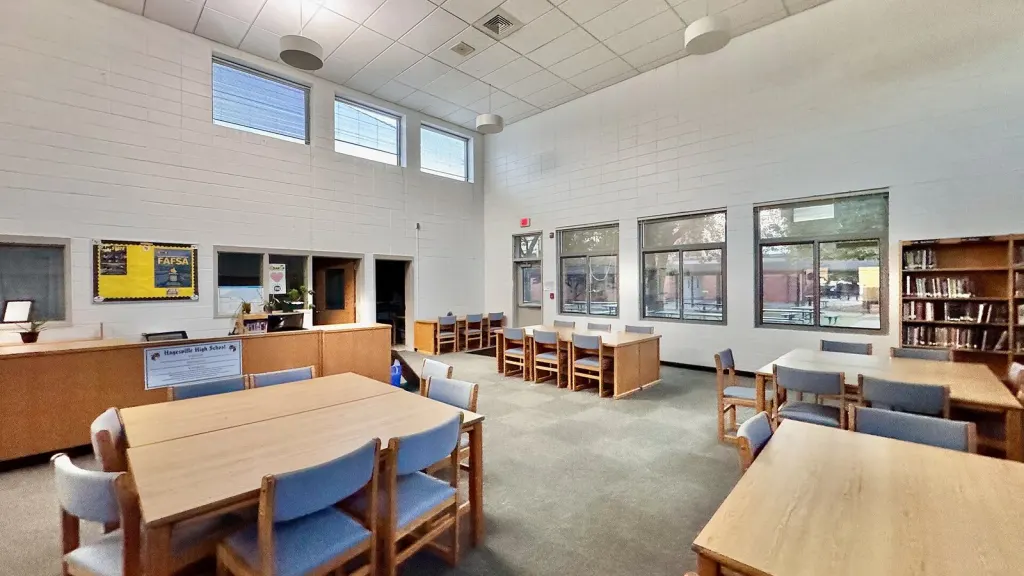
Fewer than 10% of Michigan public schools report having a library staffed by a trained school librarian, and the state ranked 46th in the nation for its student-to-librarian ratio in the 2023-24 school year, with one librarian for every 2,760 students, according to two Wayne State University researchers.
Shannon Oltmann, associate dean of information sciences, and Kafi Kumasi, a professor of information sciences, laid out the numbers in an essay published Nov. 23 by Bridge Michigan and The Conversation. They are leading a state-funded effort to survey every school in Michigan about its library.
Recommended, not required
Michigan strongly recommends that schools employ certified librarians but does not require them, the researchers wrote. The number of school librarians in the state has been falling since 2010, and the jobs remain vulnerable to budget cuts.
The shortage affects students statewide, but particularly in low-income communities like Detroit and Flint and in more isolated ones such as Alcona County in the northern Lower Peninsula and Ontonagon County in the Upper Peninsula, they wrote.
School librarians, also called school library media specialists, hold a teaching certificate and complete advanced education. Studies link strong library programs with higher achievement and better literacy, especially for struggling readers, the authors said. “A missing librarian is harder to see than an empty bookshelf,” they wrote. If students can’t borrow books and teachers have no librarian to plan lessons with, the room “offers only a fraction of what a school library can provide.”
Counting every school
Michigan’s 2025-26 School Aid budget paid for the survey, called the Michigan School Census, which launched in September 2026. By Oct. 21, 1,054 schools, about one-third of those invited, had completed it, and a public map tracks participation by district. The researchers said they want to hear from schools without libraries or librarians, too, so they can explain how students get books and research help. The findings will guide recommendations on staffing, resources and funding.
What librarians do
At a symposium the team held this year, Brian Peck, a teacher librarian at Detroit’s UPrep Academy, described helping students research and build a library where none had existed; he reported that 334 students voluntarily visited and checked out books the previous school year. At West Ottawa Public Schools, librarian Julia Reynolds replaced crowded shelves with displays that show book covers, and circulation quadrupled, she reported. West Ottawa Principal Audra Bolhuis compared a librarian to “an instructional coach” teachers can turn to for resources and classroom projects.
The researchers also stressed information literacy in the age of artificial intelligence: teaching students to trace a claim to its source, check whether the source exists and compare it with an AI-generated answer. “A confident response still needs evidence,” they wrote.
Training the pipeline
A program called Project Restoring Urban School Libraries helped classroom teachers earn the endorsement needed to become school librarians, combining mentoring with coursework that drew on students’ cultures, including hip-hop. The authors also noted that principals and librarians usually train in separate academic units, so principals may finish their training without learning how to work with one.
“Counting what schools have is the first step toward deciding what every Michigan student should be able to count on,” they wrote. More school coverage is in Education.